Silica-Free Benchtop Alternatives
The best silica-free benchtop alternatives to engineered stone are solid timber, porcelain, natural stone, and solid surface products such as Corian and Meganite. All are durable, safe to craft, and available through Smith & Smith in Melbourne.
We’ve paused our ongoing blog series about the kitchen renovation process to explore some alternative benchtop materials that can keep stonemasons safe. There are already many great options available on the market.
With increased awareness about silica and its impact on the health of those who work with it, there has been a push to find healthier alternatives to engineered stone, which typically has a high silica content and can cause silicosis if safety precautions are not taken. Silicosis is a condition that affects people working with silica-containing products. While it can be mitigated with protective equipment, it’s safer to work with materials that are silica-free or have low silica content.
Engineered stone typically contains up to 90% crystalline silica, which is what makes cutting and polishing it hazardous. The silica-safe alternatives below contain little or none, so they can be fabricated without that risk.
Here are some benchtop materials that offer a wide range of colour options and textures to complete your kitchen renovation:
Silica-Free:
Meganite: An acrylic solid surface product that can be used similarly to engineered stone, but without adverse health effects. Meganite can be rejuvenated in situ by stonemasons to a beautiful finish if scratches occur. It can also be curved, cut, fluted, and coved, making it stand out.

A silica-free Corian benchtop in Deep Nocturne elevates the drama in this black kitchen.
Neolith: A toughened ceramic similar to Dekton but more durable still. It is also heat, scratch, and stain-resistant. Flame-resistant Neolith benchtops can integrate gas burners.
Laminate: An option that has been around for many years, laminate has been improved in terms of the board it is laid on and the production process itself to make it as sustainable as possible. It remains a practical choice and offers almost unlimited colour options, from solid colours to natural-looking timber grain.
Corian: Another acrylic solid surface product that offers similar colour and design options to Meganite.
Dekton: A toughened ceramic similar to porcelain but more durable. It is also heat, scratch, and stain-resistant.
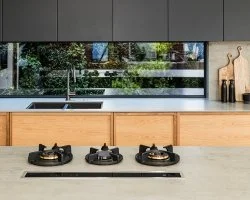
Silica-Free Neolith benchtops in Beeton provide the additional functionality of being flame-resistant. Integrated gas burners can sit directly, and SO pleasingly, within a flame-resistant benchtop.
Solid Timber: Timber is making a huge comeback this year, and Smith & Smith love to craft solid timber benchtops in their workshop in Rowville. They can be made to measure and offer warmth and texture. Timber benchtops can be used as a feature on an island bench or throughout the kitchen for a more unified effect.
Natural Stone: Some natural stone contains silica, and some are silica-free. Natural stones have a lower silica content than engineered stones, making them safer. Natural stone is heat and scratch-resistant, but it needs sealing regularly to prevent stains. It has a unique beauty that manmade alternatives cannot fully capture.

Silica-free natural stone benchtops and splashbacks make a bold and timeless statement.
Low Silica:
Lithostone: A low-silica reconstituted stone that is hard-wearing, stain and heat-resistant. It covers a wide range of colours, from solid colours to veined stone.
Porcelain: A large tile that can be placed on your benchtop, porcelain is heat, scratch, and stain-resistant.
Whether you choose a silica-free or low-silica benchtop material, you’ll have plenty of options to achieve the look you want for your kitchen renovation.
Final Notes:
The recent 60 minutes story has heightened public awareness of the dangers of silica dust and has caused many to question the wisdom of having reconstituted stone bench tops.
Each state government has either begun or is in the process of introducing regulations to protect workers from exposure to silica dust. As strange as it may seem, each state will have different compliance dates for the silica dust ‘codes of practice and regulations’. The 60 minutes story focused on several stone masons that were based in Queensland, which is due to enforce a licensing scheme on the 1st May, 2023. The ‘codes of practice’ in each state will actually apply to all construction work such as bricks, blocks, tiles, mortar and concrete, basically anything that creates dust and is dangerous when inhaled.
Victoria’s Silica Licensing scheme commenced on the 15th of November 2022. The building industry was advised (in advance) that all stone masons would be required to obtain an engineered stone license to enable them to legally purchase and process reconstituted stone after 15 November, 22.
Victoria’s new licensing system is designed to control and eliminate silica dust in the workplace and protect workers in the industry from future health issues. Many stone masons were already using the appropriate safe work practices such as ‘wet cutting’ machinery and on-tool dust extraction prior to the introduction of the licensing system. In addition, the use of respiratory equipment was a standard practice to safeguard their worker’s risk of exposure to silica dust. The new legislation enforces these safe work practices and will eliminate “cowboy” stone masons who previously did not follow safe work practices. It should be noted that silica dust particles only become dangerous when the dust is released by cutting, grinding or polishing reconstituted stone.
As of the 15th of November, 2022, unlicensed Victorian stone masons can’t legally purchase reconstituted stone. Smith & Smith’s preferred stone masons all hold Silica Licenses. In addition, Worksafe has and will continue to conduct regular inspections of stone masons’ premises to ensure they are and remain compliant with the governing ‘codes of practice’.
FREQUENTLY ASKED QUESTIONS
What are the best silica-free benchtop alternatives?
Solid timber, sintered stone, natural stone and solid surface products such as Corian and Meganite are all silica-free. Each offers strong durability and a wide range of looks.
Is engineered stone banned in Australia?
High-silica engineered stone is heavily restricted. In Victoria, a silica licensing scheme has applied since 15 November 2022, and unlicensed stonemasons cannot legally process reconstituted stone. Smith & Smith only work with silica-safe or low-silica materials.
Are silica-free benchtops as durable as engineered stone?
Yes. Porcelain and natural stone are heat and scratch-resistant; solid surface products can be repaired in place, and solid timber lasts for decades with simple care. You do not sacrifice durability by choosing silica-safe.
What is silicosis?
Silicosis is a serious lung condition caused by inhaling fine crystalline silica dust, which is released when engineered stone is cut, ground or polished. Choosing silica-safe materials removes that risk for the people who craft your kitchen.
Does Smith & Smith use silica-free benchtops?
Yes. Smith & Smith only specify reconstituted stone that is silica-free, in line with Victorian law. Our preferred stonemasons all hold silica licences.