Project: Blazey
There is a reason timber keeps finding its way back into kitchen design.
While colours, profiles and trends change, timber has an ability to make a kitchen feel immediately warmer and more connected to the rest of the home. It can soften clean contemporary lines, bring texture to a minimal palette or become the defining feature of the room.
And importantly, a timber kitchen does not have to mean one particular look.
Recent Smith & Smith projects use timber — and high-quality timber-look finishes — in very different ways. In GILLINGHAM, solid White American Oak helps create a calm Japandi feel. In LONSDALE, Boston Oak cabinetry brings warmth to an otherwise highly minimal design. PORTOBELLO uses timber tones to ground a bolder retro influence, while BLAZEY creates an expressive backdrop for colour, shape and collected objects. In CLARE, a durable timber-alternative finish works alongside soft green cabinetry and natural stone.
Different homes. Different styles. The common thread is what timber brings to the room.
Timber adds warmth without adding visual noise
Project: Lonsdale
One of timber’s greatest strengths is that it can make a kitchen feel warmer without making it feel busier.
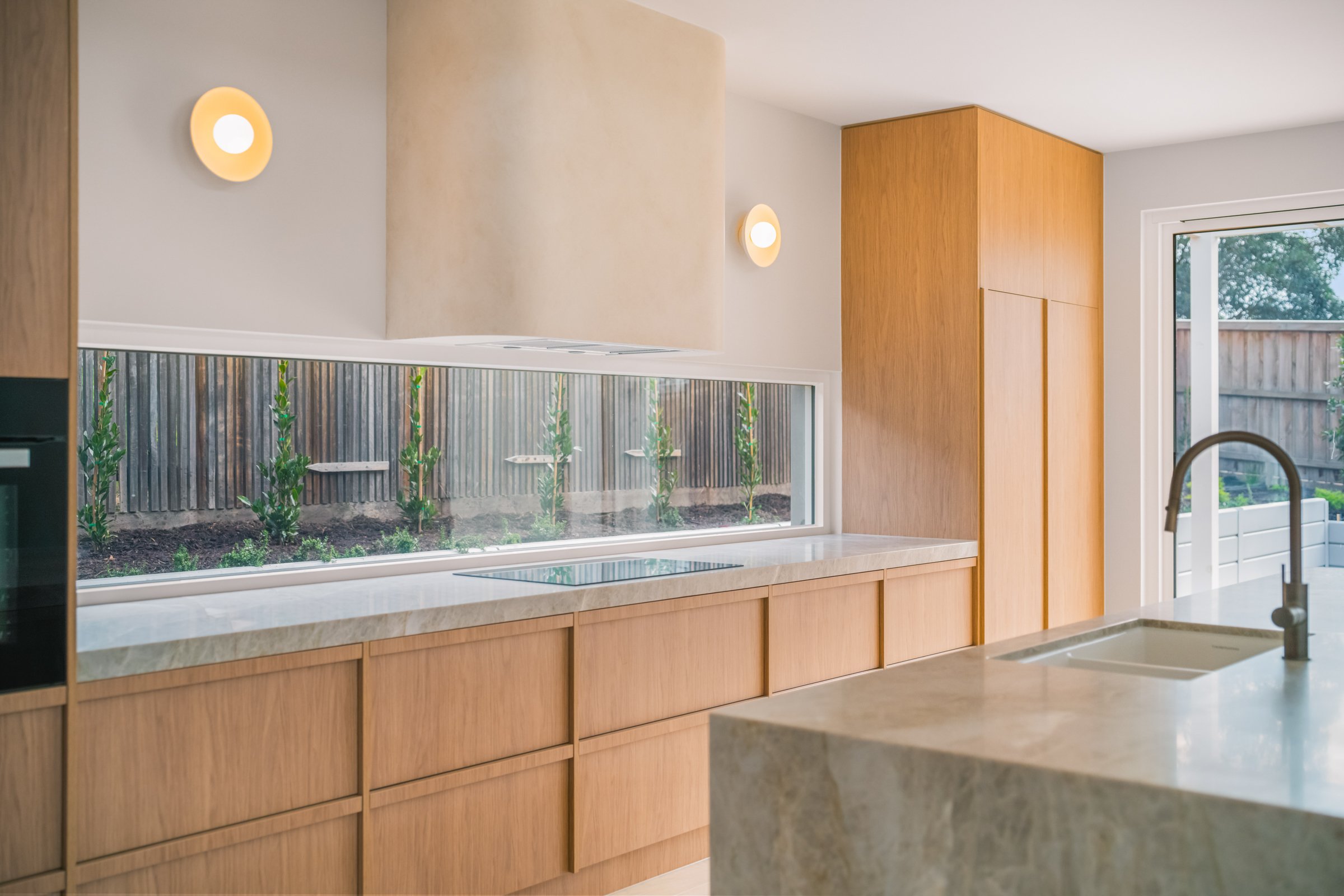
That balance is particularly clear in LONSDALE.
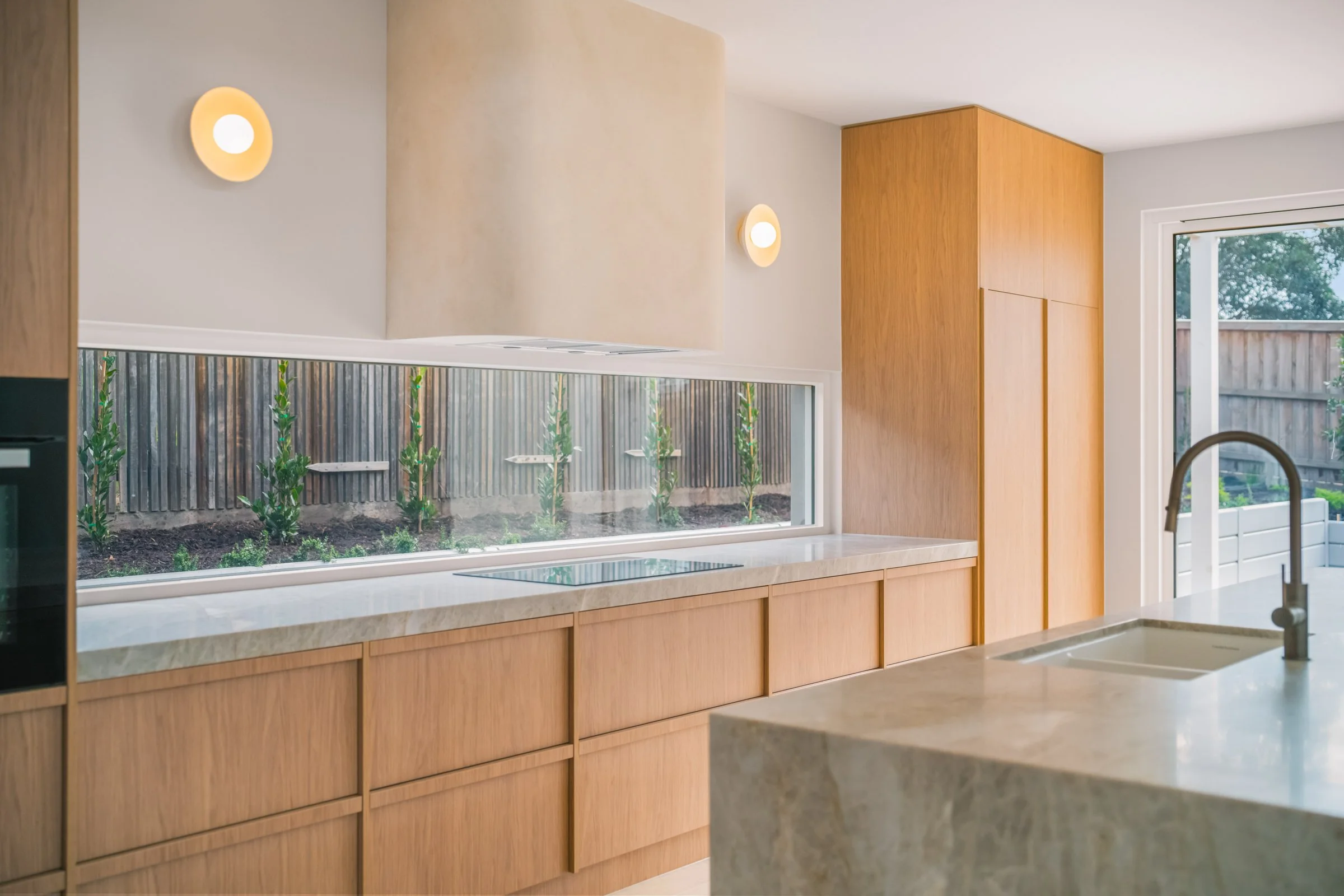
The kitchen is minimal in form, with integrated reverse J-grip handles and clean cabinetry lines, but Boston Oak Woodmatt introduces enough grain and variation to stop the room feeling stark. Taj Mahal natural stone across the benchtop and splashback adds another natural layer, while the long horizontal garden window brings greenery and daylight directly into the composition.
The sculptural island remains the centrepiece, with stone wrapping the sides, a curved edge and fluted detailing, but the timber cabinetry helps ground all of that stone.
It is an important lesson for anyone drawn to minimal design but worried about it feeling cold: you do not necessarily need more decoration. Sometimes you simply need a material with warmth.
Timber works beautifully with other natural materials
Project: Gillingham
Timber rarely needs to do all the talking.
In fact, some of the most successful timber kitchen designs pair it with materials that have their own natural variation.
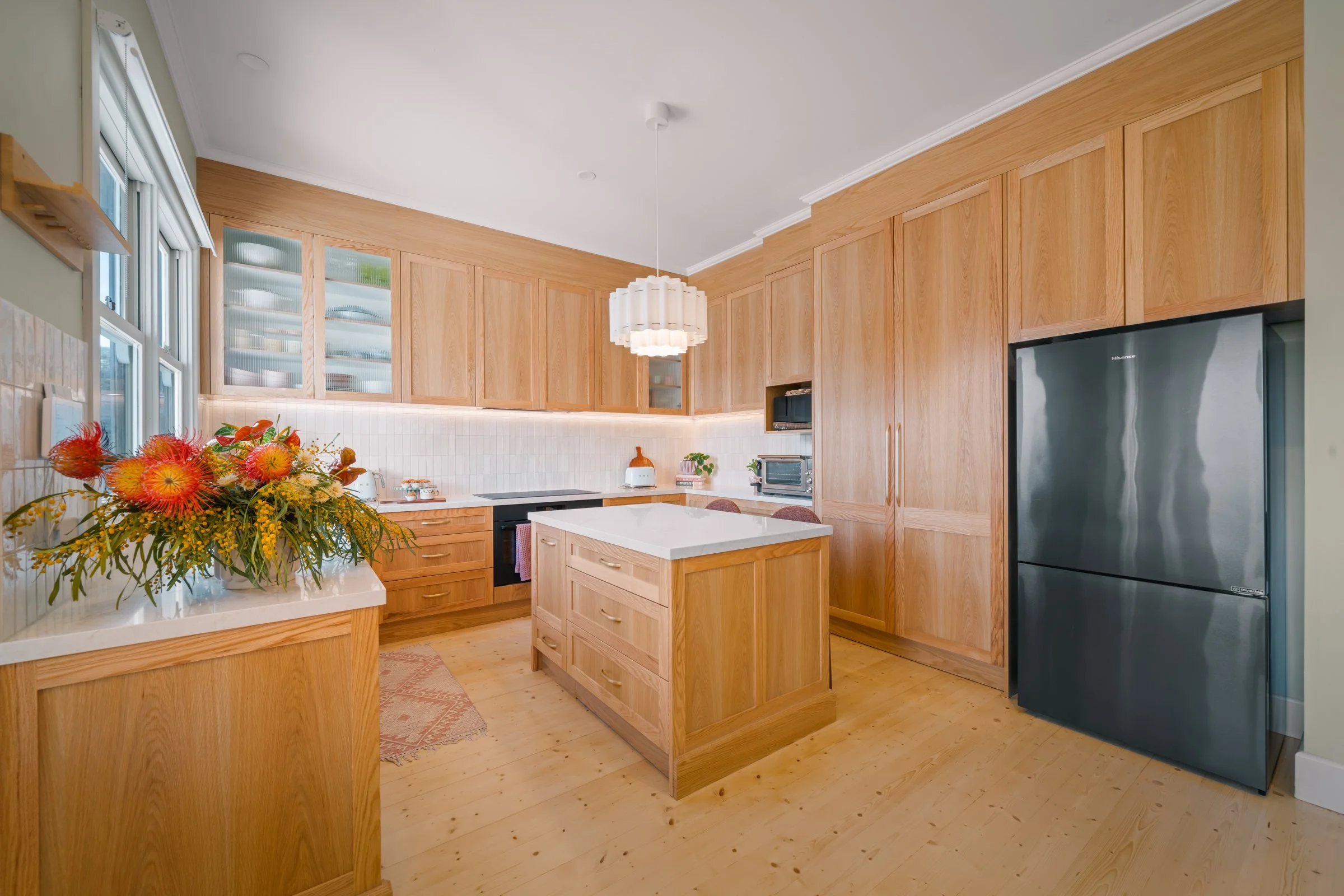
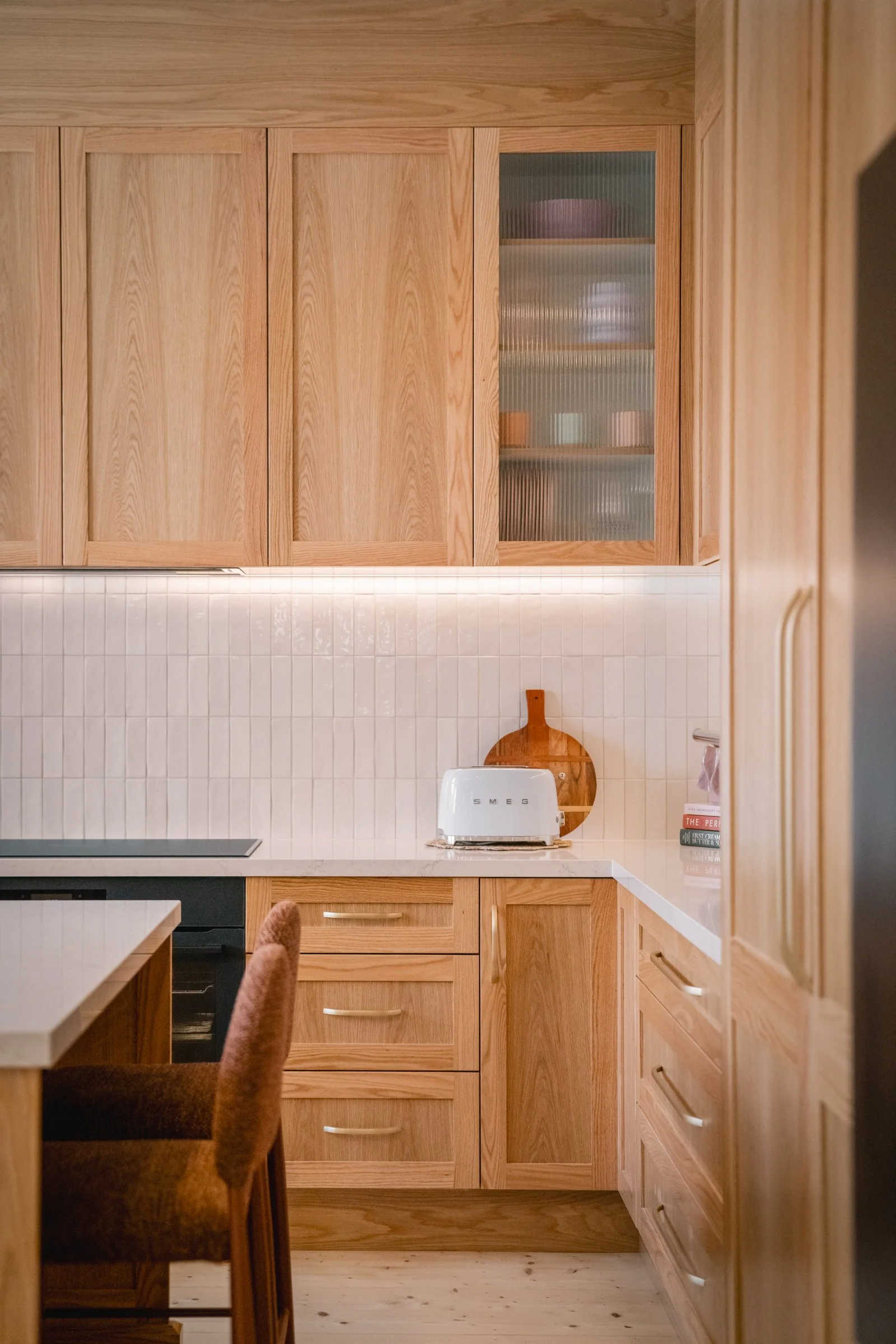
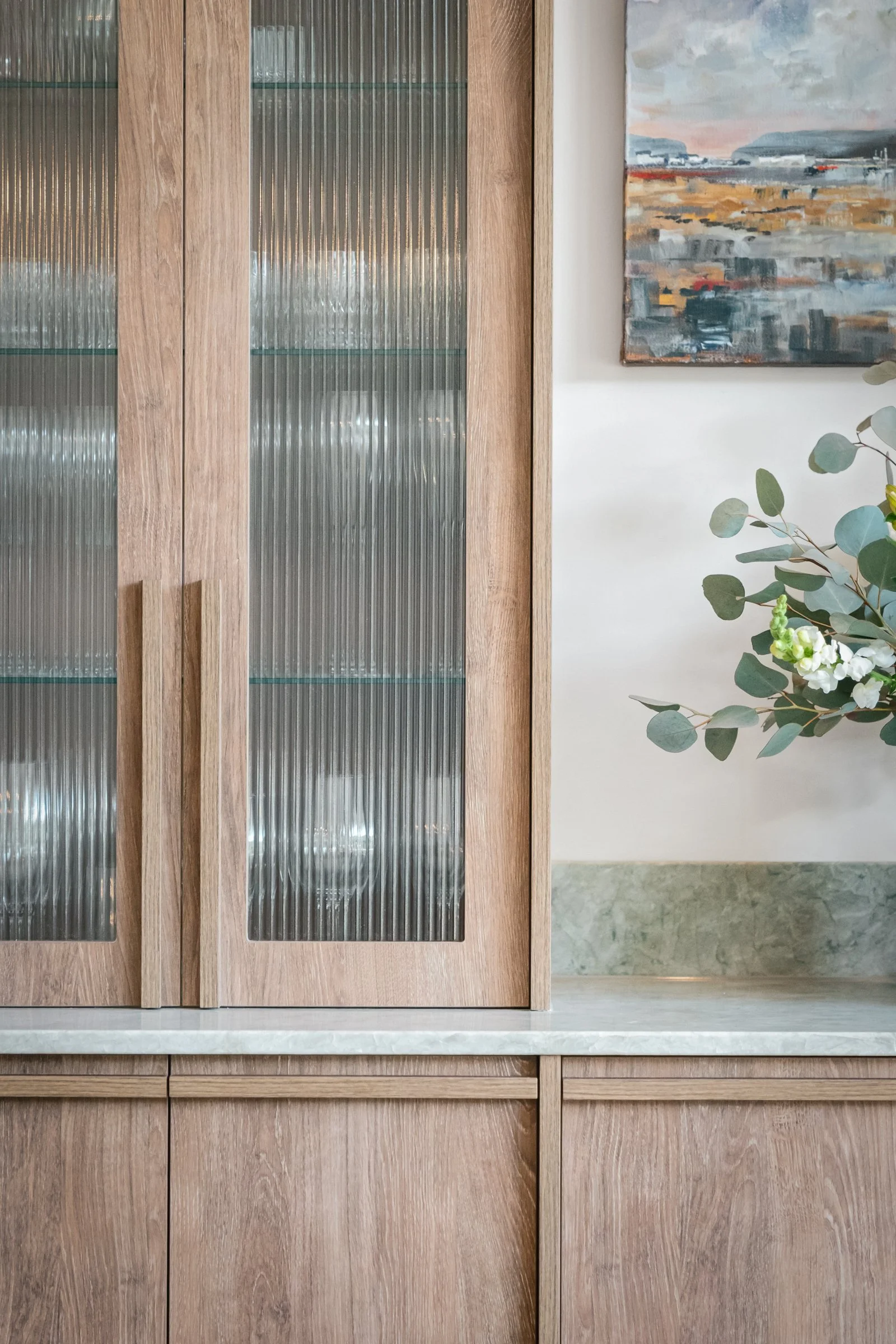
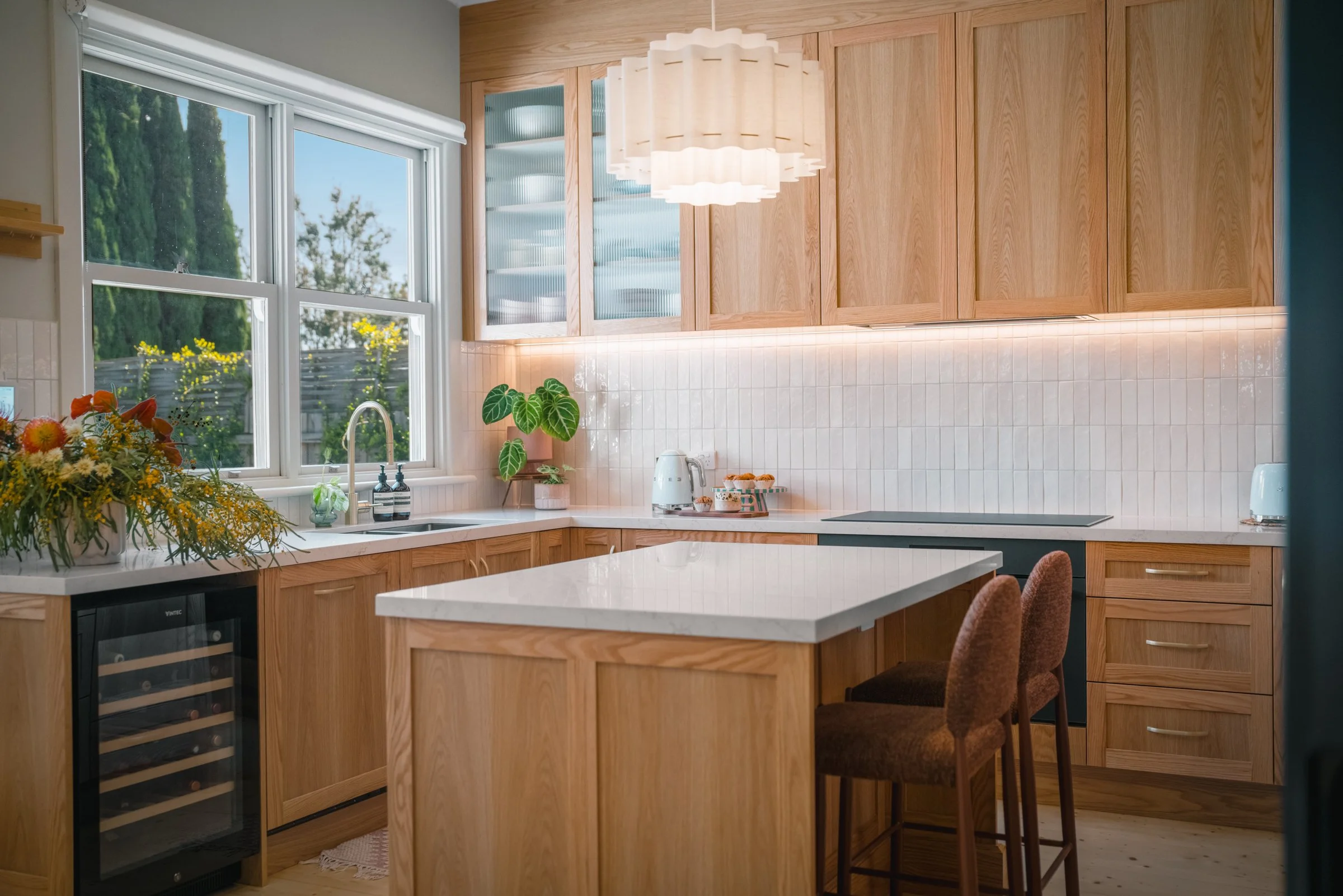
GILLINGHAM takes this approach through a Japandi-inspired palette. Solid White American Oak Shaker doors are paired with natural stone and a vertically laid, high-gloss Zellige splashback. Reeded-glass display cupboards introduce another layer of texture, while handle-free upper cabinetry keeps the overall composition calm and considered.
The different surfaces are doing different jobs.
Oak brings warmth and grain. Stone creates weight and permanence. Zellige introduces light and subtle irregularity. Reeded glass allows display without making everything completely visible.
Together, they create depth without relying on strong colour or excessive decoration.
For homeowners who want a kitchen that feels natural rather than overtly styled, this is where timber really earns its place. It sits comfortably alongside stone, glass and handmade surfaces because none of them feel perfectly uniform.
Timber can give a bold idea longevity
Project: Portobello
Choosing a kitchen with personality can feel risky. What looks exciting today can raise the inevitable question: will I still love it in ten years?
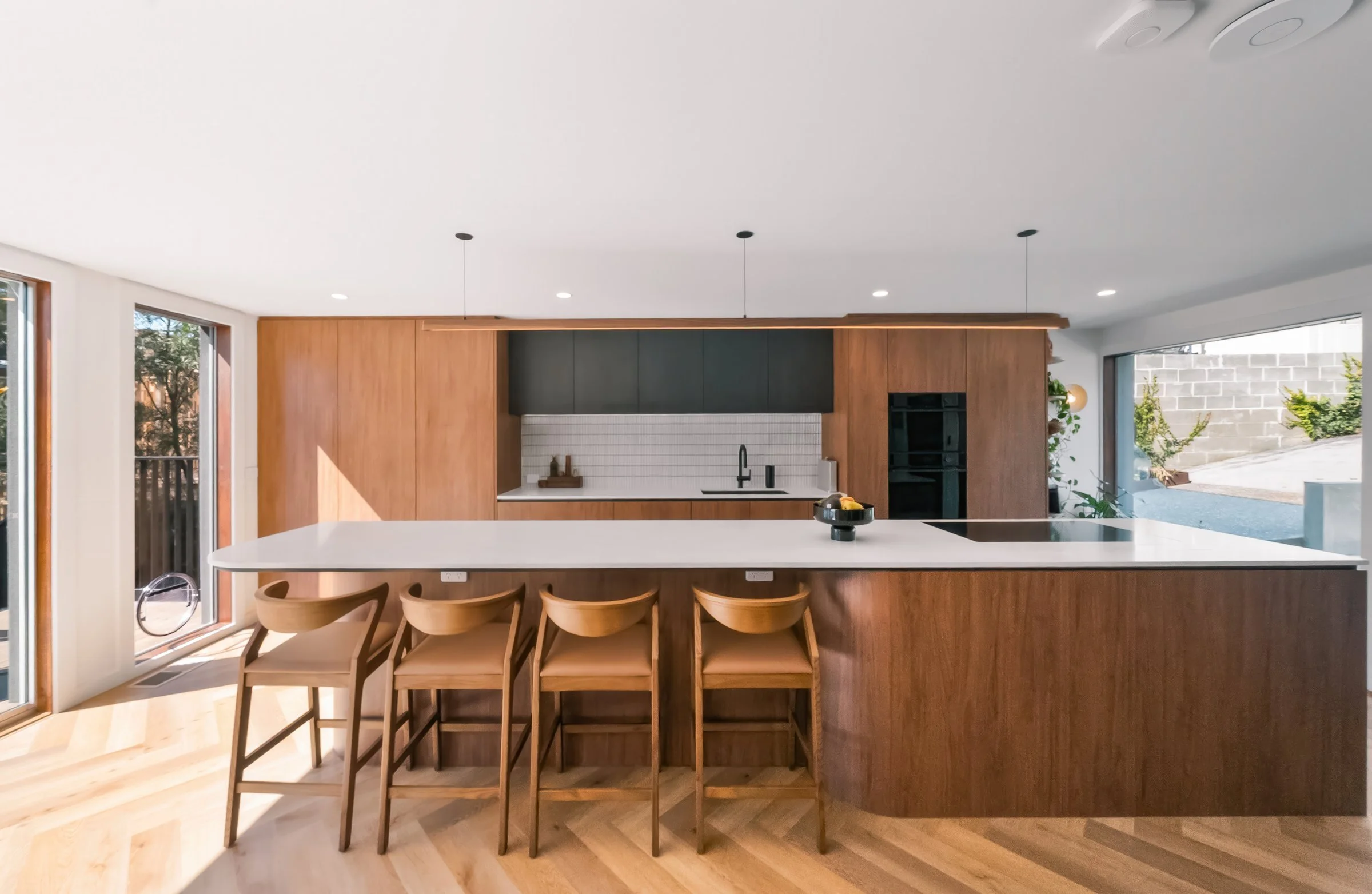
PORTOBELLO is a useful example of how timber can provide the grounding element that allows a stronger design idea to go further.
The homeowners loved the warmth and personality of retro interiors, but did not want their kitchen to feel like a recreation of a particular era. Instead, the design borrowed the qualities they were responding to — warm timber tones, darker cabinetry, soft curves and a little more character — and balanced them with contemporary planning and functionality.
Woodmatt laminate allowed the warmth and texture of timber to run across a substantial amount of cabinetry, while offering the durability required in a family kitchen without the cost of solid timber throughout.
Around it, the layout stays highly resolved. A galley cooking zone keeps preparation efficient. A separate coffee and breakfast station reduces congestion during busy mornings. The generous 1200mm-deep island provides both preparation space and a natural gathering point, with a curved benchtop softening the straighter lines of the kitchen. Integrated appliances and a downdraught rangehood keep sightlines clean.
PORTOBELLO shows that timber does not have to make a kitchen conservative. Used thoughtfully, it can actually give you the confidence to be bolder — providing enough familiarity and warmth to keep a more expressive design feeling balanced and enduring.
Timber can make a minimal kitchen warm and inviting
Clean lines are useful in a kitchen. They make spaces easier to read and can help smaller rooms feel less crowded.
But clean lines alone can sometimes feel clinical.
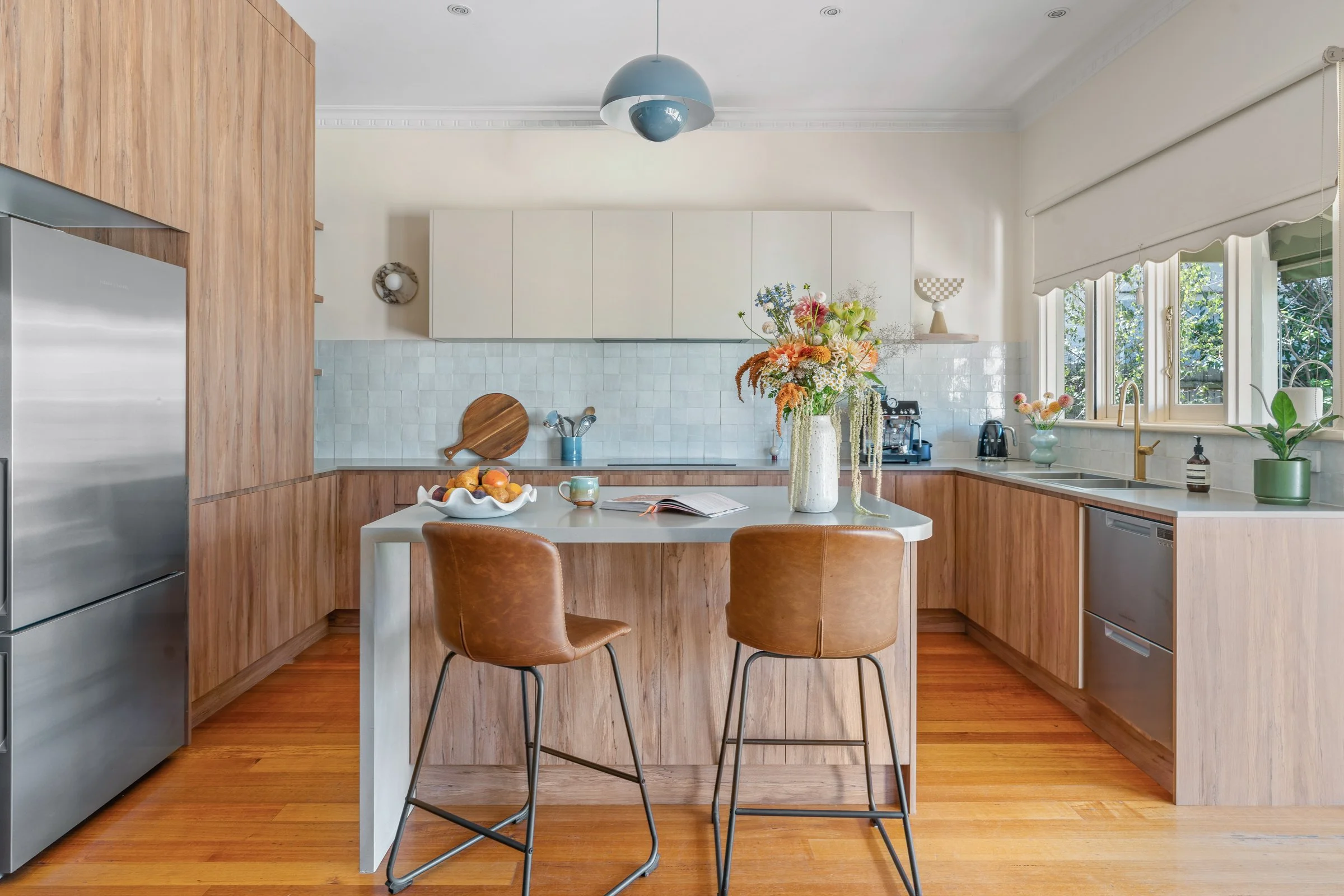
BLAZEY shows how timber and timber tones can change that.
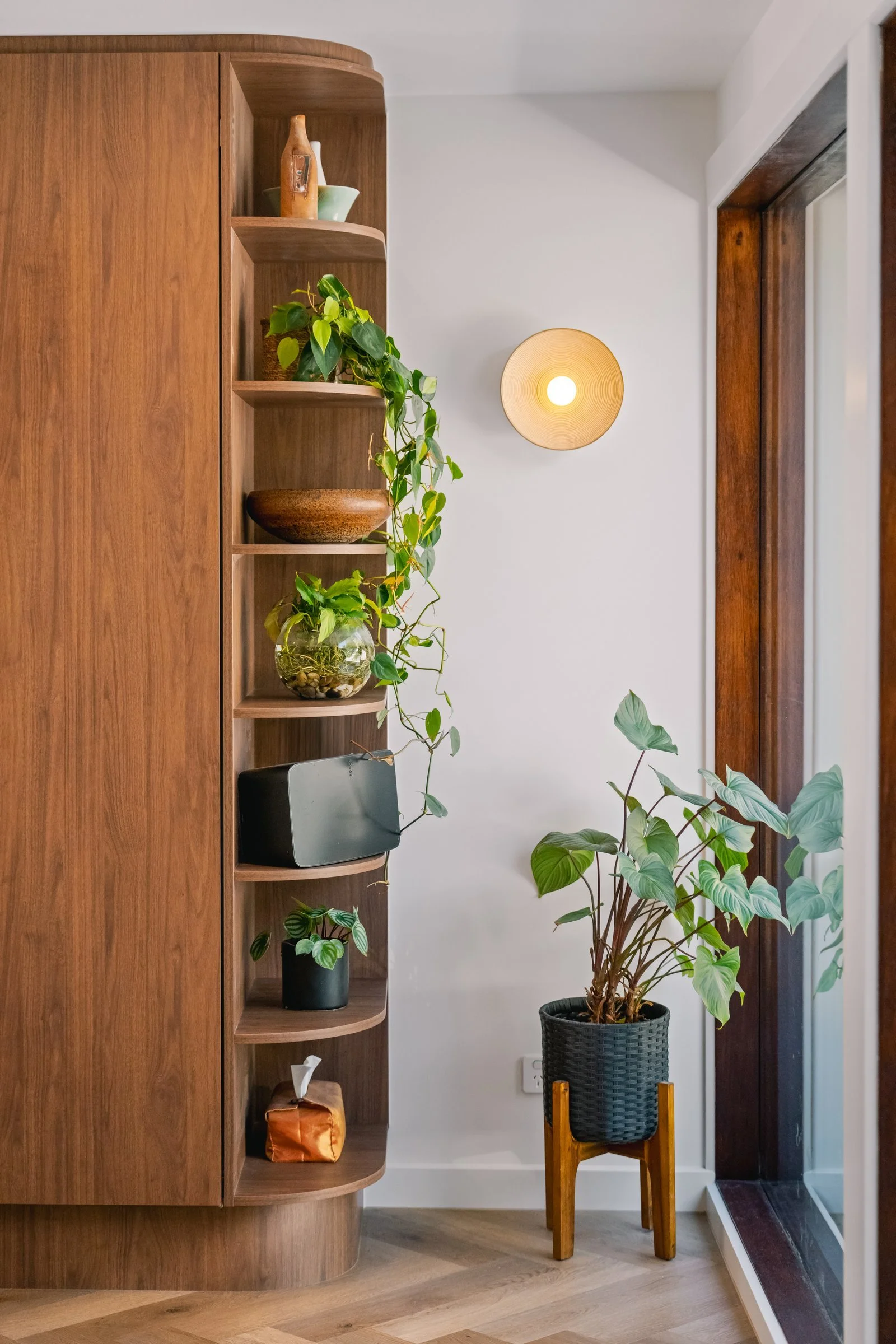
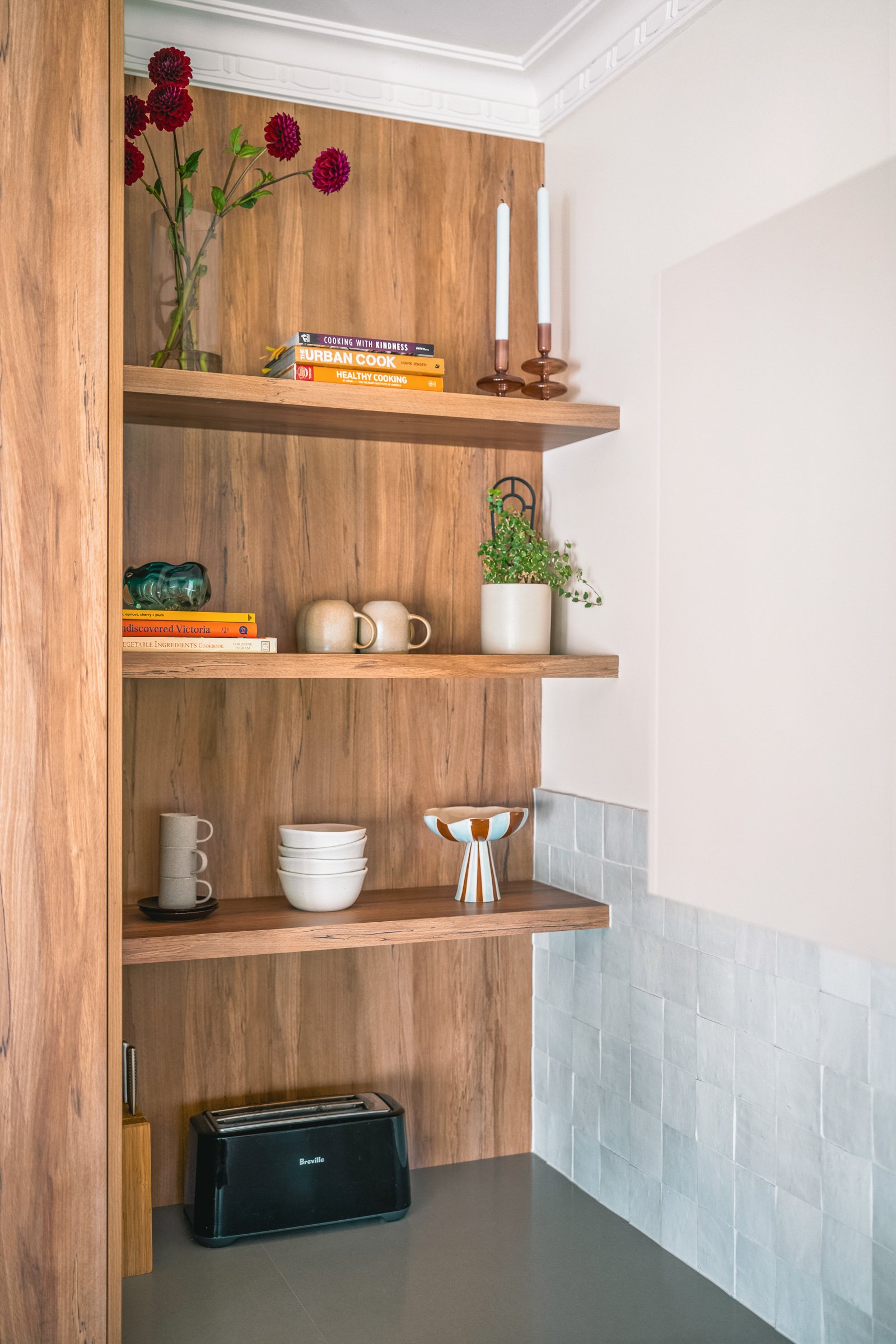
Designed for a young family in Preston, the kitchen needed more usable preparation space and less visual bulk. Removing the large corner walk-in pantry opened the room and created an opportunity for floating timber shelves against a timber backing board.
From there, the design became a study in lines and curves. A strong horizontal band of overhead cabinetry is balanced by a solitary curved shelf. A round light punctuates an otherwise quiet wall. Earthy brown laminates keep the palette warm, while the open shelving gives the homeowners somewhere to introduce their colourful 1980s Memphis-inspired homewares.
The result is not rustic and it is not traditionally “timber”.
Instead, the warmth of the timber elements gives a highly composed, contemporary kitchen enough softness for personality to sit comfortably within it.
That is often what timber does best: it takes the edge off minimalism.
Timber can connect the kitchen to the living space
Project: Clare
As kitchens become more open to dining and living areas, they increasingly need to feel like part of the furniture of the home.
Timber is particularly effective here because we already associate it with dining tables, shelving, flooring and freestanding furniture.
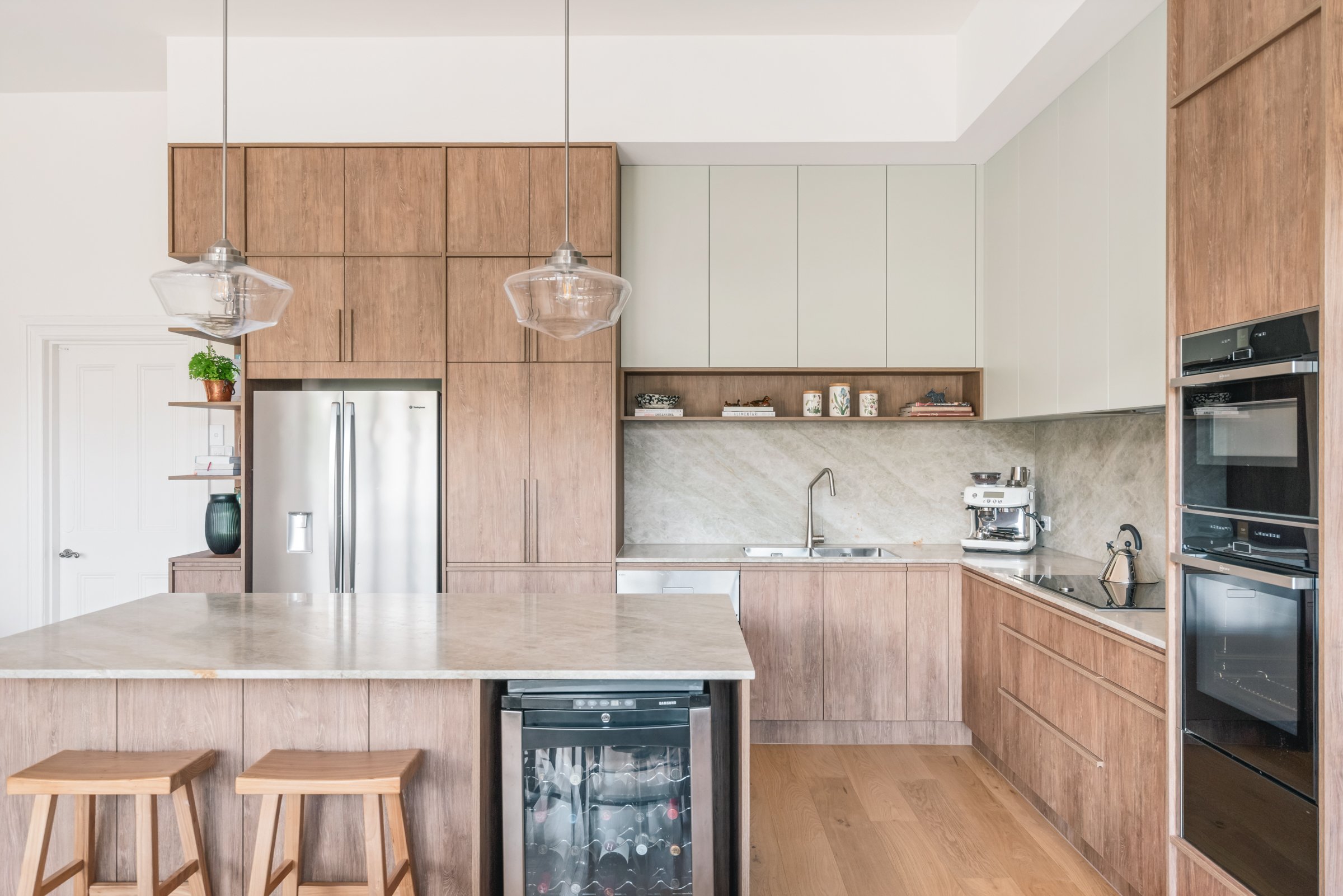
CLARE uses that idea particularly well.
The kitchen is visible from the lounge, dining area and outdoors, so every elevation needed to feel resolved. A premium timber-alternative finish is paired with soft green doors carrying grey undertones and natural stone with a subtle green vein.
On the dining side, the cabinetry becomes lighter and more decorative. Reeded-glass cupboards, glass shelves and a deliberate pause for artwork make the joinery feel less like a working kitchen and more like furniture belonging to the living space.
That visual warmth is backed by practical planning: the sink was moved closer to the fridge and pantry, a continuous benchtop improves prep flow, and dedicated storage for wine, cookware and pantry items supports the way the family entertains.
Timber is not simply there to make the kitchen look warm. It helps the kitchen belong to the room around it.
Real timber or timber-look? Both have a place
Project: Gillingham
Project: Portobello
Project: Clare
Project: Blazey
Project: Lonsdale
One of the useful things these projects demonstrate is that achieving the warmth of a timber kitchen does not mean every surface needs to be solid wood.
GILLINGHAM uses solid White American Oak, where the natural material itself is central to the character of the design.
LONSDALE and PORTOBELLO use Woodmatt finishes to introduce convincing timber warmth and texture within highly functional contemporary kitchens.
CLARE uses a premium timber-alternative finish where durability was an important consideration for a busy family.
And BLAZEY mixes floating timber elements with earthy laminates rather than attempting to make every cabinet the same material.
The right choice depends on where the material is being used, the desired aesthetic, budget, maintenance expectations and the demands of everyday family life.
What matters is not whether every timber-looking surface came from a tree. It is whether the material has been chosen deliberately and works with the rest of the room.
Why timber kitchens continue to endure
Project: Gillingham
Perhaps the reason timber performs so consistently — both in homes and in the images people respond to — is that it offers something many kitchens need: balance.
It can warm white.
Give a bold design direction familiarity.
Soften stone.
Ground colour.
Bring texture to minimal cabinetry.
Connect a kitchen to timber floors and furniture elsewhere in the home.
And because every grain, tone and combination creates a slightly different result, timber can feel timeless without making every kitchen look the same.
GILLINGHAM uses it to create Japandi calm. LONSDALE uses it to soften architectural minimalism. PORTOBELLO uses it to give a retro-inspired idea warmth without tipping into theme. BLAZEY uses it as a grounded backdrop for expressive shape and colour. CLARE uses it to help an open-plan kitchen feel more like beautifully considered furniture.
That range may be timber’s greatest advantage.
Rather than dictating a style, it adapts to one.
If you find yourself repeatedly saving timber kitchens for inspiration, it may be worth looking beyond the material itself and asking what you are responding to: the warmth, the texture, the connection to nature, or simply the way the room makes you feel.
That is often the better place for a kitchen design conversation to begin.